


Tom Brown has spent more than twenty-five years pursuing apples—more specifically, lost apples. Here’s our conversation with him.
Interview by Kurt Dusterberg
Photos courtesy of Tom Brown
In 1999, while working as a research engineer at R.J. Reynolds Tobacco Company, Tom Brown and his wife made their usual Saturday visit to the local farmers market in Clemmons, North Carolina. Brown happened upon a man selling a variety of heirloom apples.
“And I was just totally fascinated by all the colors and taste and interesting names of the apples,” Brown says.
Ever since, Brown has been on a mission, one that has consumed his retirement. He spends most of his days in search of heirloom (or “heritage”) apples—varieties that were cultivated and grown in the past century. Some are extinct, while others have whereabouts unknown. That might sound like an unnecessary pursuit, but Brown has taken great interest in the historical significance of the varieties. Not only does he enjoy the detective work, but once he finds an existing tree from a long forgotten variety, he takes pride in giving it new life, if only for other enthusiasts and orchardists.
At 85, Brown has catalogued more than 1,000 forgotten varieties. “This is a unique love,” he says. “Even if people care about what you’re doing, there’s only so much they can contribute. I’m the one carrying the banner for all of this.”
Your first apple encounter at your local farmers market left quite an impression on you, didn’t it?
Well, I also found out that he had discovered a few of those himself. I asked him if there were any that he was looking for from my county (Forsyth), and he was looking for one called Harper Seedling. I had zero credentials and I had never found a heritage apple. But back then, a lot of people subscribed to the newspaper and I got quite a few responses to my ad. I eventually found four or five locations where the Harper Seedling had been grown.
What compelled you to keep doing it?
In my work, I was a researcher. And success breeds success. And everybody likes apples, so people responded kindly and were helpful. What really spurred me on was everybody kept saying, “You ought to go to Wilkes County and look for old apples.” What they didn’t know was that Wilkes County was the mother lode of old apple varieties. I eventually found 300 varieties related to the one county.
Were you just able to find existing trees?
People there really valued the old apple varieties. They had kept the old trees alive. They knew the varieties and could help identify them. Sometimes the people who had the tree knew the names, but in many instances, they didn’t know the name but maybe someone else seven miles away could. Maybe they used to have the tree and could help identify it.
So how did you set out to find all these apples?
Half of Wilkes County was only an hour drive from my house, and I was retired and could go up there three days a week. Eventually I found local people who would help me make the contacts. If there was a widow who had an old apple tree, (my contact) could knock on the door and she would invite us into her living room to talk apples.
Were you just interested in cataloguing them? How could you be sure you were identifying them properly?
What I wanted to do was get them back in circulation. When I was finding them most readily, I would collect real apples, and I would mail the apples to about six people who sold heritage apple trees. Any that they liked, I would get cuttings in the fall so they could graft them. So it wasn’t just finding them, it was to get a real tree growing at another location. I got probably 600 varieties to different people. Eventually I started selling apple trees myself.
How did you go about making contact with apple people?
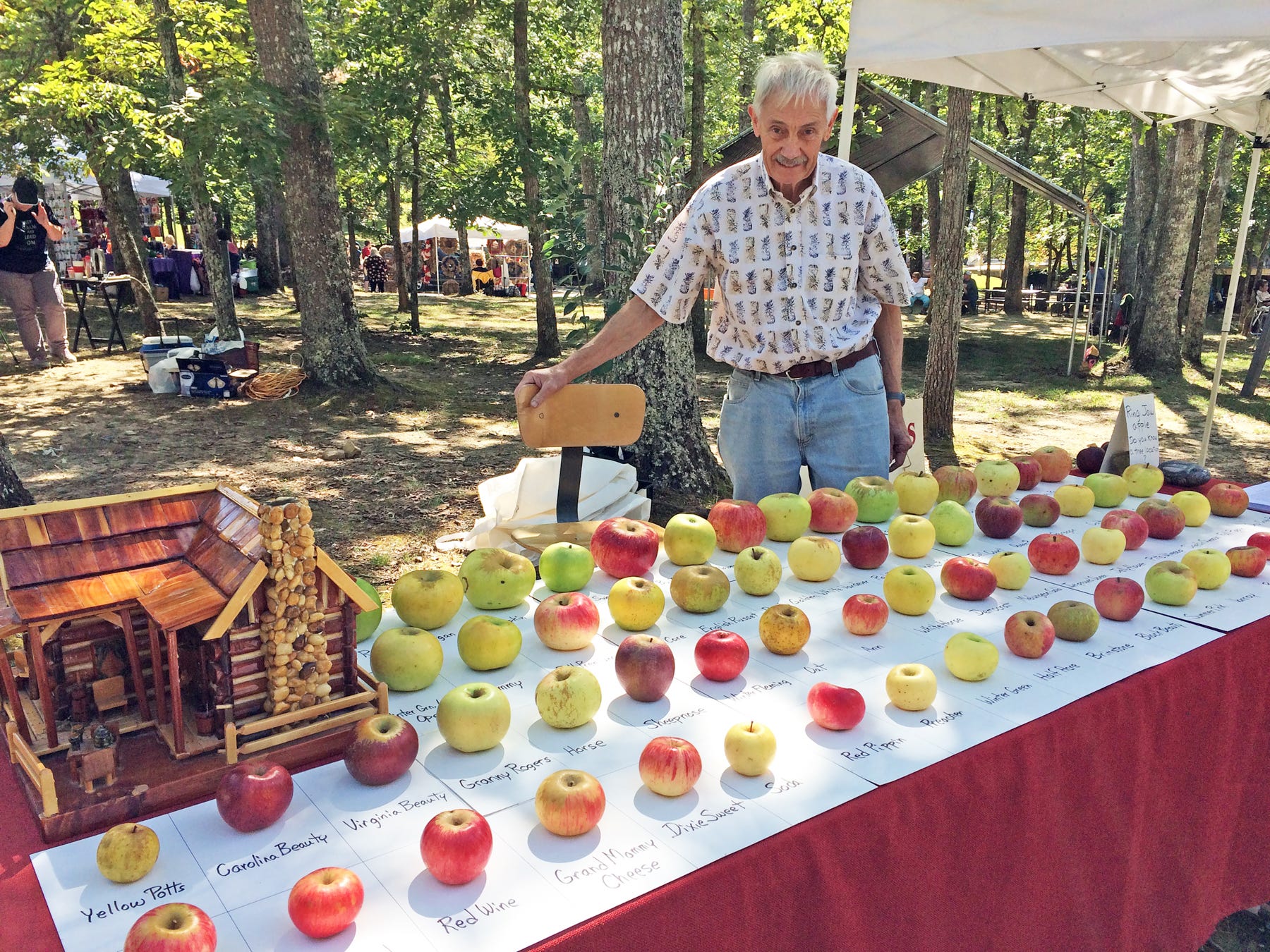
One of my most productive methods was, I would go to festivals. I would have a display where I would have seventy-two apple varieties. I’ve gone to as many as fourteen festivals a year, probably about 180 total … way up into West Virginia and as far as Cadiz, Kentucky. I have a spiral notebook and I write down their comments, whether they tell me to go visit so-and-so. And to the best of my ability, I try to follow up on them.
I would think it’s difficult to locate these trees just based on a conversation with someone.
One attribute is I’m really, really persistent. There was one apple called the Barker’s Liner apple south of Nashville (North Carolina). Somebody south of Nashville remembered the apples. So I contacted these people, and I sent them maybe five different boxes that vaguely resembled the Barker’s Liner. The man actually asked me to stop sending the apples.
Do you grow your own trees?