


Here’s Part 2 of Tom Poland’s feature about Revolutionary War battles.
Camden | August 16, 1780
I walk past monuments and flags, past where Redcoats mortally wounded beloved Continental officer Maj. Gen. Baron de Kalb, born Johann Kalb. Past where five Patriots fell. Past where a member of Fraser’s Highlanders died and is buried. The 71st Regiment of Foot, Fraser’s Highlanders, was a prominent British infantry regiment raised to serve in the American Revolutionary War. Lt. Gen. Simon Fraser composed the unit of two battalions recruited from the Scottish Highlands. They were elite, battle-hardened, and feared for their skill with the bayonet.
Bayonets and Camden’s battlefield make me uneasy. Its little white wildflowers possess leaves with stinging hairs. Think swords dipped in toxins. Think stinging defeat. A British bayonet charge would scatter Patriots like a covey of South Georgia quail, and Lord Charles Cornwallis regulars would crush Maj. Gen. Horatio Gates’s unseasoned men. That’s the short of it.
The long of it began with dragoons. Now there’s a terrifying word, dragoon. Armand’s Legion, a Continental Army cavalry unit, i.e. dragoons, and Gen. Sir Banastre Tarleton’s dragoons collided unexpectedly early morning on the Great Wagon Road. They skirmished, withdrew, and waited on dawn.
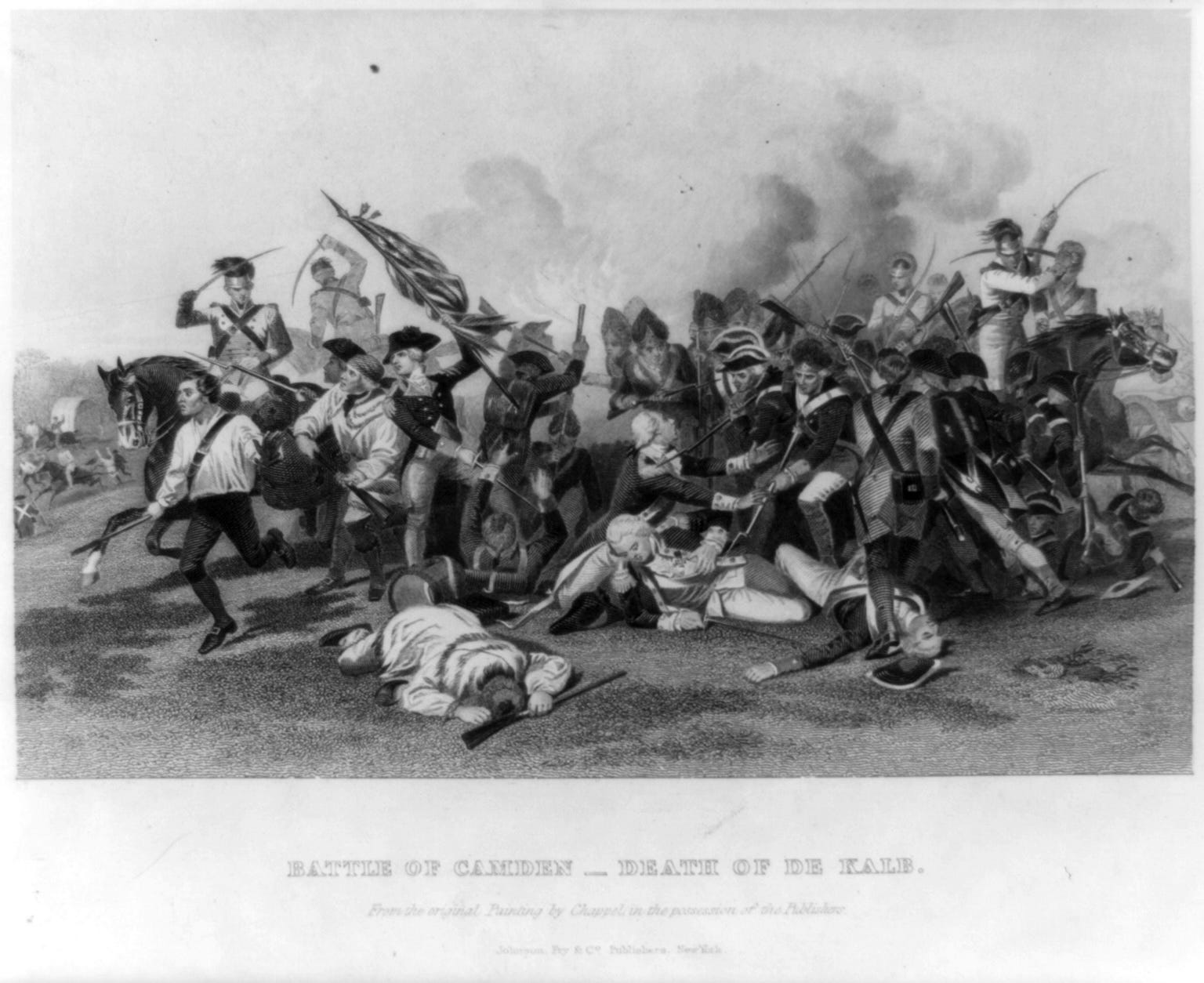
As major conflict brewed, Gates positioned Maryland and Delaware Continentals on his right flank, while placing inexperienced Virginia and North Carolina militia on his left. Gates’s raw militia directly faced elite British regulars. The British 23rd and 33rd Regiments met the advancing Virginians with a disciplined bayonet charge. Lacking bayonets and experience, the Virginia militia fled without firing a shot, followed quickly by the North Carolina militia. A disaster was unfolding.
Maryland and Delaware Continentals, led by Maj. Gen. Baron de Kalb, launched successful counterattacks against Lord Rawdon’s wing. British Col. James Webster, wheeled his troops to strike the exposed Continental flank. Surrounded and outnumbered, the Continentals were broken when Tarleton’s cavalry charged their rear. Retreat turned into “rout and slaughter” where Bloody Ban’s dragoons killed many over a 20-mile chase.
Baron de Kalb received eleven wounds—shot thrice and bayoneted over and over. Upon seeing de Kalb, Cornwallis said, “I am sorry, sir, to see you, not sorry that you are vanquished, but sorry to see you so badly wounded.” Cornwallis supervised the dressing of de Kalb’s wounds by his own surgeons in Camden. As he lay dying, de Kalb reportedly told a British officer, “I thank you, sir, for your generous sympathy; but I die the death I always prayed for; the death of a soldier, fighting for the rights of man.”
He died three days later.
