
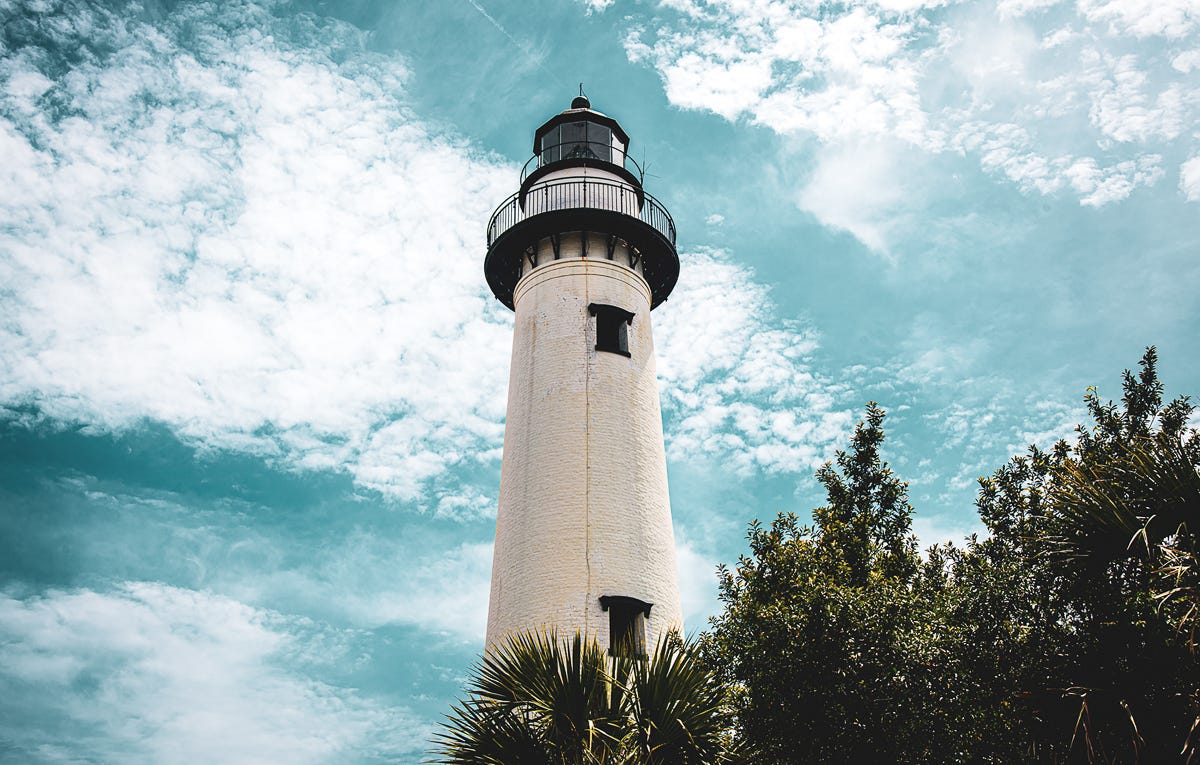
This week, we head to Florida for the fourth installment of our five-part series on the covert Southern missions that helped make America’s freedom possible, with a focus on Spain’s campaign in the Revolutionary War. But first, here’s a brief history of the Amelia Island Lighthouse in Fernandina Beach, pictured above and included in our Summer 2026 Sentinels of the Shore travel feature.
The Amelia Island Lighthouse
215 O’Hagan Lane
Fernandina Beach, Florida
The Amelia Island Lighthouse, built in 1838, is Florida’s oldest surviving lighthouse and the only one built during the state’s Territorial Period (which began in 1821 after the United States acquired the wilderness territory) that escaped major reconstruction. The lighthouse guided sailing ships and, later, modern freighters and fishing boats into Fernandina Harbor.
In 2001, the Amelia Island Lighthouse was transferred from the U.S. Coast Guard to the City of Fernandina Beach, where it remains an active beacon maintained by the Coast Guard with local Auxiliary support. The city offers limited public tours of the historic landmark and Saturday ground access. Tours cost $10 per adult and $5 per child. It’s worth a visit if you’re in the area.

Revolutionary Secrets, Part 4
Spain’s Southern Campaign
The Southern campaign of the Revolutionary War was not solely Anglo-American. Before Spain entered the war in 1779, Louisiana’s interim governor, Bernardo de Gálvez, smuggled critical supplies—gunpowder, muskets, uniforms, and medicine—through the British blockade to Patriot forces via the Mississippi and Ohio Rivers.
After Spain declared war on Britain, Gálvez captured British ports in Pensacola, Mobile, Biloxi, and Natchez with around 500 soldiers and two ships. His greatest victory was at Pensacola, where Spanish forces took the city by land and sea. The attack lasted from March 9 to May 10, 1781 and greatly reduced the number of British forces and ships that could be sent to Cornwallis at Yorktown, which contributed to Cornwallis’ impending surrender.
As a free subscriber, you can preview this feature. Consider upgrading for full access.
Thanks for dropping by! If you like what you see here, consider subscribing.